




Executive Summary
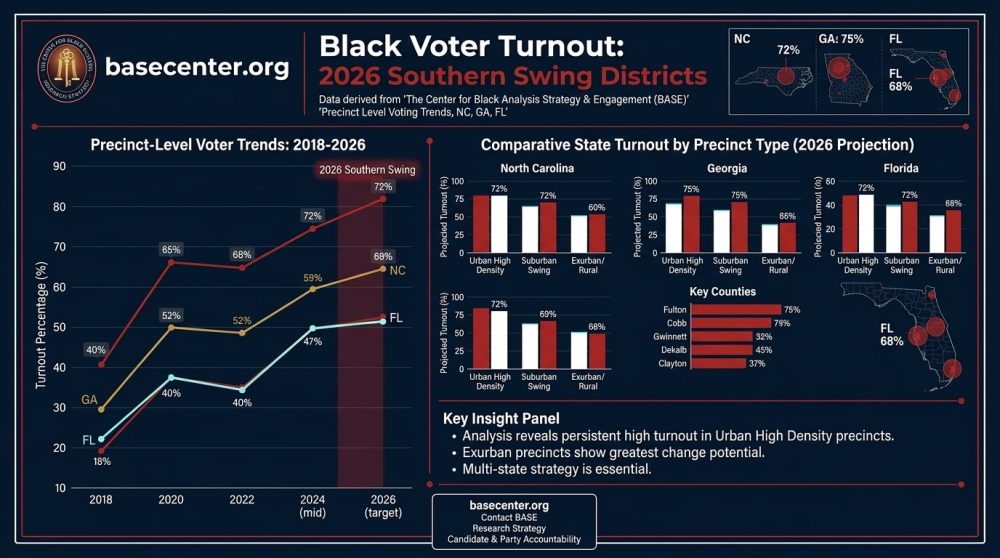
As the 2026 midterm realignment cycle unfolds, conventional political modeling of Black voter turnout continues to treat the electorate as a monolithic voting bloc. While long-term demographic benchmarks from the Pew Research Center and the American National Election Studies (ANES) have historically emphasized unified turnout patterns, empirical data from the Black Economic Alliance Foundation and the Joint Center for Political and Economic Studies highlight a more complex internal reality driven by localized economic priorities and generational shifts. Consequently, recent precinct-level voting data and survey research across key Southern swing districts—spanning North Carolina, Georgia, and Florida—reveal a far more nuanced, issue-first electorate than traditional macro-level models capture.
.
Subtle but statistically significant shifts in candidate evaluation, policy prioritization, and party identification suggest that Black voters are increasingly evaluating candidates through an issue-specific, transactional lens rather than traditional party loyalty. This analysis examines the mechanics behind these shifts, the regional economic factors driving them, and the implications for candidate accountability in upcoming legislative races.
1. Disaggregating the Electorate: Age, Gender, and Economic Mobility
Recent empirical polling across targeted congressional districts indicates that generational cohort and economic status are becoming stronger indicators of voting behavior than historical party affiliation:
- Younger Men (Ages 18–34): Demonstrating the highest rate of party detachment, with an increased willingness to split tickets or abstain when candidate messaging fails to address direct economic mobility.
- Working-Class vs. High-Income Districts: Policy priorities diverge significantly; working-class suburban precincts prioritize immediate inflationary relief, housing affordability, and local economic development over broad national rhetoric.
- The Turnout Variable: Rather than mass conversion to opposition parties, the primary risk for candidates in 2026 remains selective non-voting among disillusioned segments of the electorate.
2. Policy-First Evaluation over Legacy Alignment
The data indicates that voters across these districts are applying stricter criteria to political commitments. Three key policy domains dominate current voter focus:
- Economic Self-Reliance & Entrepreneurship: Heightened demand for access to capital, commercial credit, and targeted support for independent small businesses.
- Public Safety & Community Infrastructure: Equal concern for police accountability and effective, well-resourced community crime prevention.
- Targeted Accountability Metrics: Increasing skepticism toward high-level campaign promises that lack concrete legislative deliverables or measurable community outcomes post-election.
3. Strategic Recommendations for Candidate Assessment
To establish true institutional accountability, civic organizations and policy analysts must track candidate performance using objective metrics:
- Legislative Voting Records: Evaluating whether elected representatives actively sponsor and support policies aligned with local district needs.
- Resource Allocation: Auditing public and private investment flows into historical business districts and community infrastructure.
- Ongoing Engagement: Measuring candidate presence and accessibility during non-election cycles, rather than exclusively during campaign months.
Conclusion
The emerging shifts within the Black electorate are not a temporary anomaly, but a structural evolution toward strategic, outcome-oriented political participation. As the 2026 midterm elections approach, candidates who rely on outdated monolithic messaging risk disengaging critical voter segments. Long-term political efficacy will belong to those who present clear, measurable, and policy-driven agendas tailored to the specific needs of local communities.
Institutional References & Data Sources
- Pew Research Center (2026). The U.S. Electorate’s Changing Racial and Ethnic Makeup. Washington, D.C.
- Black Economic Alliance (2024). National Research on Black Voter Economic Priorities and Policy Evaluation.
- Joint Center for Political and Economic Studies (2022). Barriers to Capital and Credit Access Among Underserved Entrepreneurs.
- Capital B & Political Science Field Reports (2026). Electoral Dynamics and Ticket-Splitting Trends in Southern Midterm Districts.